
Fat Fish Incident
How teriyaki sauce affects browning on grilled chicken products
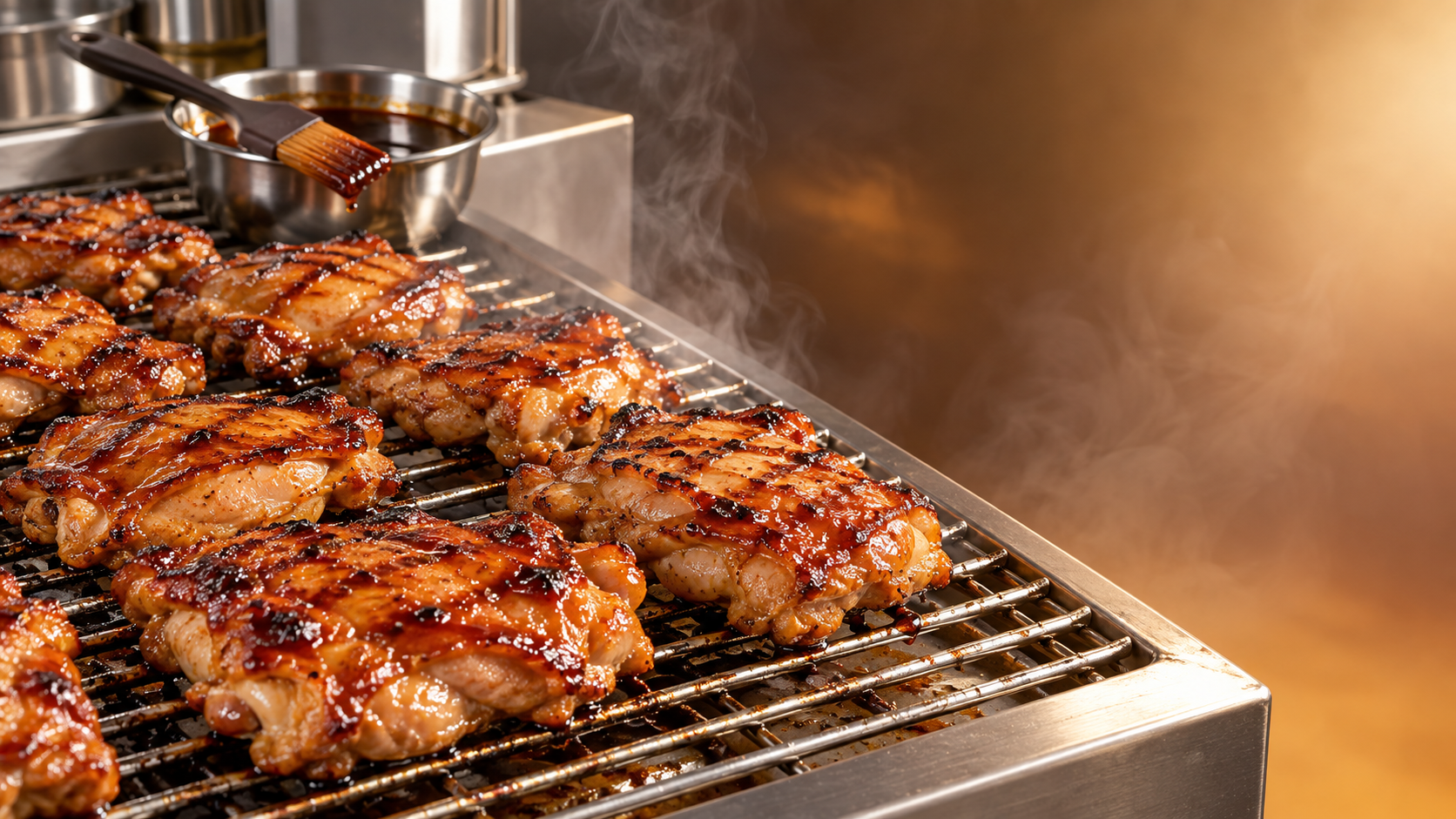
The brown, glossy surface associated with grilled teriyaki chicken is not created by sauce alone. It results from the interaction between sauce solids, chicken surface moisture, grill heat, airflow, and the point at which the sauce is applied. Teriyaki sauce can produce an attractive mahogany-to-golden finish, but the same ingredients that support browning—especially sugars and amino-containing soy components—also make scorching one of the most common production problems.
The practical rule is simple: use dry heat to develop the chicken’s initial color, then use teriyaki sauce to build the final glaze in controlled layers. Applying a sugar-rich sauce too early exposes it to intense grate or flame heat before excess water can evaporate. The result may look dark, but it can carry bitterness, uneven black spots, or a sticky surface that tears when turned.
Why teriyaki sauce browns so quickly
Teriyaki sauce is not a single formula. Commercial and kitchen-made versions may contain soy sauce, sugar, brown sugar, honey, glucose syrup, mirin, sake, fruit concentrates, garlic, ginger, starch, oil, and flavor enhancers. Their browning behavior differs because the balance of sugar, salt, water, protein-derived compounds, and acidity differs.
Two heat reactions matter most. Caramelization occurs when sugars are heated to sufficiently high temperatures. It contributes darker color, toasted sweetness, and a slightly roasted aroma. The Maillard reaction occurs between reducing sugars and amino compounds. Soy sauce and other fermented seasonings can supply amino acids and peptides that support this reaction, while chicken proteins also contribute once the surface becomes hot and dry enough.
In practice, these reactions overlap. A teriyaki glaze may become deeper in color because sugars concentrate as water evaporates, because amino compounds react with sugars, and because the sauce forms a thin film that reflects light differently from bare grilled meat. A glossy dark finish is therefore not always evidence of heavy browning. It may be partly a surface-coating effect.
The difficulty is that sugar does not need a long exposure to high heat to darken. On a grill, local contact points can become much hotter than the average cooking environment. A sauce that appears stable over indirect heat can burn within seconds over a flare-up or at a grate hot spot.
Initial surface dryness determines whether the glaze looks clean or blotchy
Chicken coming from a wet marinade, thawing process, or wash step carries surface water that delays browning. Heat is first consumed evaporating that moisture. If teriyaki sauce is brushed onto that wet surface, it becomes diluted and runs into thin, uneven tracks. Those tracks may dry at different rates, leaving patchy color: pale in one area, nearly black in another.
Patting the chicken dry before grilling does not mean removing all marinade flavor. It means avoiding free water on the exterior. The chicken should be allowed to drain after marination, and any excess pooled sauce should be removed before it reaches the grill. This creates a more uniform starting surface and reduces dripping, flare-ups, and waste.
Skin-on and skinless products require different expectations. Chicken skin renders fat as it heats, which can improve surface heat transfer and crispness but can also trigger flare-ups. A thick teriyaki layer on skin often becomes dark before the fat beneath has fully rendered. Skinless thigh meat tends to accept glaze well because its irregular surface holds a thin coating, while breast meat can dry out if operators wait too long for a deep color that the lean surface does not naturally develop.
For portion-controlled products, surface area matters as much as weight. Thin strips, diced skewers, and small boneless pieces heat rapidly and have a high sauce-to-meat ratio. They require lighter applications and shorter finishing exposure than large bone-in pieces. Using one brushing schedule for every cut is a reliable way to create inconsistent color.
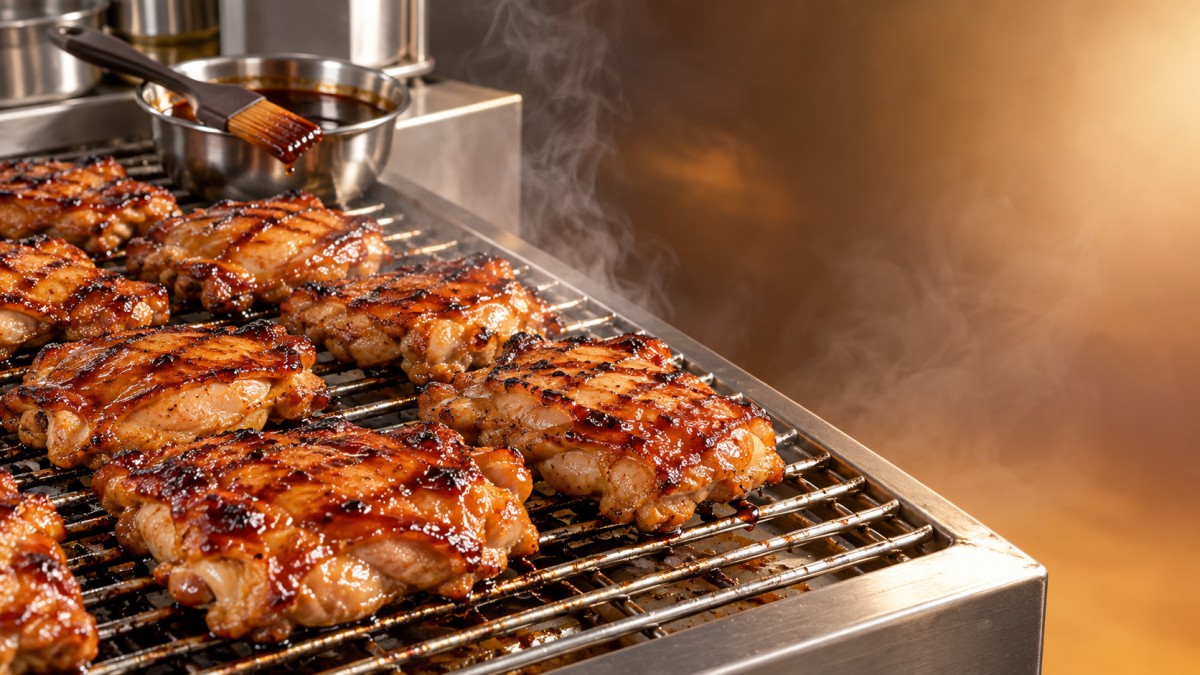
Application timing has more influence than adding more sauce
For most grilled chicken formats, sauce should be treated as a finishing glaze rather than the main cooking medium. Start with chicken that has already begun to set on the grill. Once the surface has developed light browning and the meat releases cleanly from the grate, apply a thin coat, close the lid or move the product to a less aggressive heat zone, and allow the film to tighten before turning.
A second or third light coat produces a more even lacquered finish than one heavy coat. Thin layers lose moisture quickly and form a stable glaze without excessive pooling. Heavy brushing creates a wet layer that can slide off, drip onto burners or coals, and burn before it adheres.
The final coat is best applied when the chicken is close to its required internal doneness rather than at the beginning of cooking. It can then set with a short controlled exposure to heat. The exact endpoint should follow the food-safety procedure used by the operation and the chicken product specification; visual browning cannot verify safe cooking.
Holding finished chicken over direct heat to “make it darker” is a frequent error. Once the glaze has reached a desirable sheen and color, extra exposure changes the flavor faster than it improves appearance. The darker result may be perceived as roasted from a distance but can taste burnt, especially where garlic, ginger, or soy solids have concentrated.
Heat management: direct heat creates color, indirect heat protects the glaze
Grill temperature readings can be misleading because they describe the equipment environment, not every point of contact on the cooking surface. Grates above flame or heavily loaded charcoal can develop local hot zones. Chicken positioned over these areas may blacken on the edges while the rest of the batch remains pale.
A two-zone cooking arrangement gives better control. Direct heat is useful for setting grill marks and developing initial browning on unglazed or lightly seasoned chicken. Indirect heat, a raised rack, or a cooler grill zone is useful after teriyaki sauce is introduced. The sauce can reduce and adhere without being exposed continuously to the most severe heat.
Flare-ups need to be addressed immediately, not treated as part of the browning process. Dripping glaze burns on the heat source and deposits smoke and soot-like flavors on the product. Move the chicken away from the flame, reduce the fuel or burner intensity where possible, and avoid brushing more sauce into the affected area. A clean grill surface also matters: carbonized residue transfers dark marks and bitter notes to fresh glaze.
For conveyor, clamshell, or impingement-style equipment, the same principle applies in another form. High airflow accelerates surface drying, so a thin glaze can set quickly. Yet rapid drying may create a dark skin while the sauce underneath remains tacky if the coat is too thick. Adjustment should begin with sauce solids and coating weight, not simply with longer residence time.
Sauce formulation changes the operating window
The browning window is the range between “glaze has set attractively” and “sugars have scorched.” A high-sugar sauce has a narrower window. Honey, brown sugar, molasses-like ingredients, and fruit concentrates can give desirable color and flavor, but they demand lower finishing heat or shorter exposure. A thinner, soy-forward sauce may tolerate a slightly longer set time but can appear less glossy unless applied in multiple coats.
Starch-thickened sauces behave differently from reduced sauces. Starch can help the glaze cling, especially on skewers and irregular cuts, but an overly thick sauce may sit on the surface rather than flow into a thin film. It can form a dull, paste-like layer and darken unevenly. If a sauce is difficult to brush evenly, dilution or formulation adjustment may be more useful than increasing grill heat.
Salt has an indirect effect. Soy sauce contributes salt, and salty marinades can alter surface moisture movement during cooking. More importantly, a very salty, dark sauce can visually mask early scorching. Operators should assess color in good working light and taste samples from different grill positions rather than relying only on how dark the surface appears.
Acidity also affects perception. A sauce with vinegar, citrus, or fruit acidity may taste balanced even with significant browning, while a low-acid, high-sugar glaze can become cloying or bitter more quickly. This does not make acidic sauce “safer” on a grill; it simply changes the flavor threshold at which dark color becomes unacceptable.
Separate marinade management from finishing glaze control
Using the same teriyaki sauce for raw chicken marination and final brushing introduces both quality and food-safety concerns. Once a sauce has contacted raw poultry, it should not be used as a ready-to-eat finishing glaze unless it is handled and cooked according to the operation’s validated food-safety process. The simpler control is to reserve a clean portion for finishing and keep raw-product marinade separate.
Marination can add soy, ginger, garlic, and sweet notes below the surface, but it does not eliminate the need for a controlled glaze step. In fact, heavily marinated chicken may brown more quickly because dissolved solids remain on the exterior after draining. When the product already carries a sweet marinade, the finishing sauce should usually be applied more lightly.
Consistency begins before the grill. Sauce batches should be mixed thoroughly because settled solids change both viscosity and browning intensity. Cold sauce often brushes more thickly than sauce at a controlled service temperature, leading to heavier coating weights. Measuring a practical application amount per portion or per batch is more useful than relying on a vague instruction such as “brush generously.”
Where a producer develops fermented seasoning components in-house, environmental stability influences flavor repeatability before grilling ever begins. Equipment such as a Fermentation device, with separately controlled heating and humidifying functions, may support controlled food-processing conditions where its temperature and humidity range matches the specific process. It should not be assumed that such equipment alone establishes a safe or complete soy-sauce fermentation process; ingredient culture, salt level, process duration, sanitation controls, and validation remain process-specific.
Color defects and what they usually indicate
A nearly black edge with a pale center usually points to excessive local heat, a flare-up, or an overly thick sauce deposit near the edge. Reduce direct exposure and inspect whether sauce is pooling in folds of skin or around bone joints.
A dull brown coating that wipes or flakes away suggests that the sauce did not have time to set, was applied too thickly, or was placed on a wet surface. Let the first layer tighten before turning, and avoid adding a second layer until the first no longer looks wet.
Patchy pale areas may result from uneven brushing, cold chicken entering the grill, wet surfaces, or crowded loading that prevents heat circulation. They can also occur when product is turned before the surface has released. Better loading spacing and a consistent drain time often correct the problem without changing the sauce.
Dark color with weak teriyaki flavor usually means the sauce was overheated rather than properly layered. Aromatic compounds can be lost or distorted under severe heat, while bitter notes become more prominent. The remedy is not extra sauce after burning has occurred; it is a lower-intensity finishing stage that preserves the intended glaze flavor.
A workable control routine for repeatable results
Before service or production, check the sauce for separation, viscosity, and temperature. Confirm that chicken pieces are similarly sized, adequately drained, and not carrying excessive free marinade. Keep the grate clean and establish a cooler zone before glazed product is loaded.
During cooking, build initial color on the chicken first. Apply a thin teriyaki coating only after the surface has begun to dry and set. Use the cooler zone for glaze development, watch for flare-ups, and turn with care so the coating is not scraped away. Add another light layer only when needed for gloss and flavor intensity.
After cooking, evaluate more than color. The useful standard is a surface that is evenly browned, lightly glossy, adherent, and free of bitter char, while the chicken meets the operation’s required doneness and handling controls. A deep brown finish is desirable only when it comes from controlled concentration and grilling—not from burnt sugar.
Teriyaki sauce is therefore best understood as a heat-sensitive finishing system. Its sugars create color, its soy-derived components deepen savory browning, and its viscosity determines how it forms a glaze. Once application weight, surface dryness, and finishing heat are controlled together, grilled chicken can achieve a repeatable appearance without sacrificing flavor or creating unnecessary scorching risk.
Tag
Related Products


Leave A Message
If you are interested in our products and want to know more details, please leave a message here, we will reply you as soon as we can.


