
Fat Fish Incident
How to assess a Japanese Panko supplier for consistent crumb size
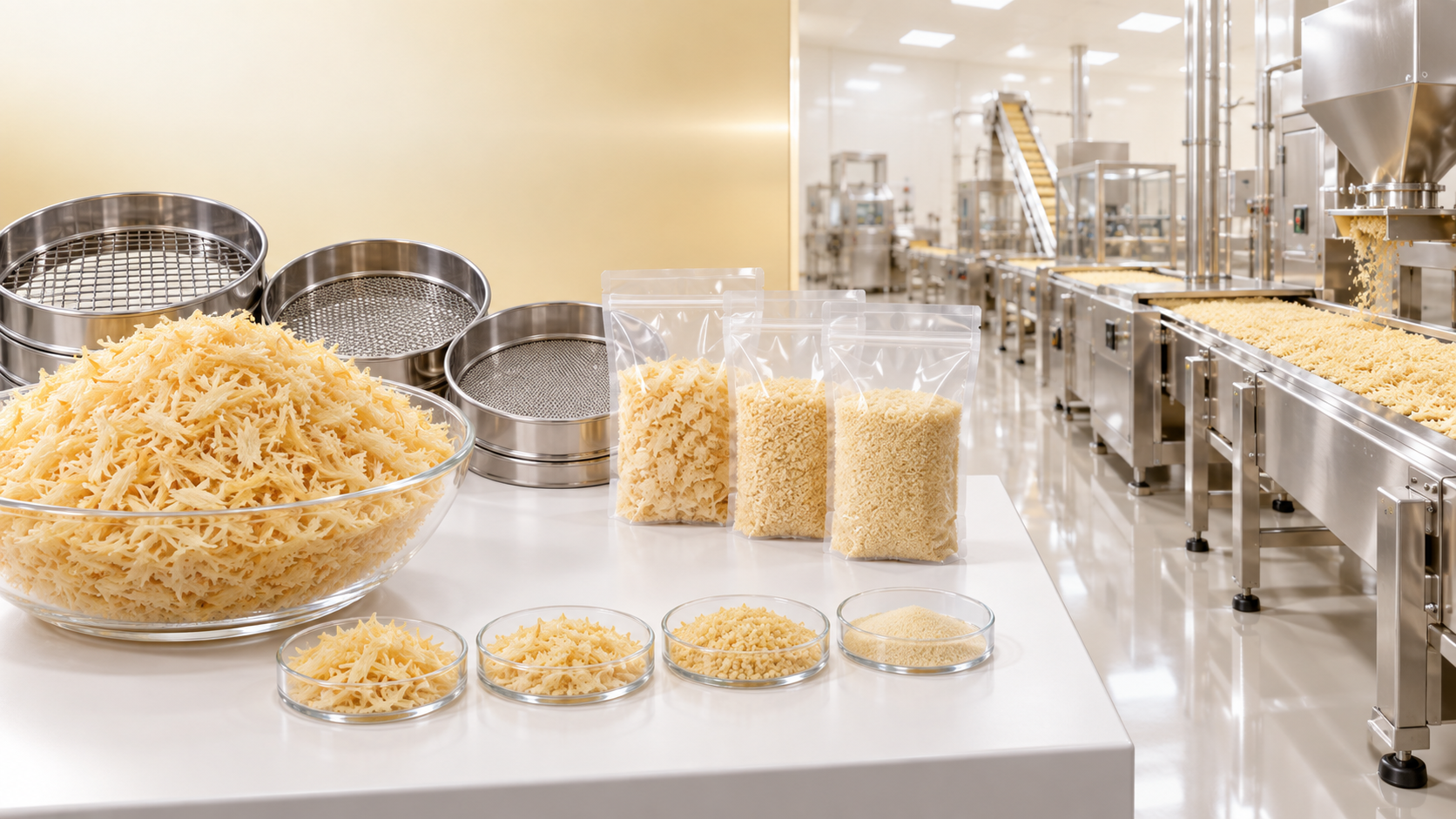
How to Assess a Japanese Panko Supplier for Consistent Crumb Size
Choosing a Japanese Panko supplier is not simply a matter of comparing colour, price, or a single sample bag. For quality and food safety teams, crumb-size consistency affects the entire coating process: pickup rate, visual coverage, fryer behaviour, crunch, oil retention, yield, and the repeatability of the finished product. A panko that looks acceptable in a laboratory tray can still create line-level variation when fine particles accumulate, long crumbs break during handling, or moisture changes from one delivery to the next.
The right assessment starts with a practical question: can the supplier repeatedly produce the crumb distribution your product and process actually require? That question must be answered with measurable specifications, representative samples, process evidence, food safety documentation, and a realistic review of supply continuity. “Japanese-style” is a description of a crumb format and eating experience; it is not, by itself, evidence of controlled manufacturing.
Define “consistent” before comparing suppliers
Many purchasing specifications state only a nominal particle size, such as 5–6 mm. That is useful, but incomplete. A nominal size does not reveal the percentage of fines, oversize fragments, dust generated after transport, or the acceptable lot-to-lot shift around the target. Two products labelled 5–6 mm may behave very differently in a breading system if one has a wider size distribution or contains more fractured material.
Before engaging a Japanese Panko supplier, define the attributes that matter in your own operation. For a formed chicken portion, the priority may be even coverage and controlled pickup. For shrimp, seafood, onion rings, or sweet potato balls, the coating may need to cling to a curved or moist surface without producing bare spots. A foodservice item expected to remain crisp after holding needs a different balance from a frozen product designed for consumer oven preparation.
Ask internal production, R&D, and QA teams to agree on the testing language. At minimum, the purchase specification should clarify the target crumb range, permitted fine and oversize fractions, shape expectations, colour tolerance, moisture target or limit, foreign-material controls, packaging format, and sampling method. Without a common sampling method, suppliers and buyers can both claim consistency while measuring different portions of the same lot.
Look beyond an average particle-size claim
A supplier should be able to explain how crumb size is monitored and how the product is released. Sieve analysis is commonly relevant for particulate ingredients, but the important issue is not merely whether sieves are used. Ask which sieve sizes are used, how often checks are performed, how samples are drawn, whether results are recorded by batch, and what happens when a result falls outside the agreed range.
A good technical discussion should also cover the difference between production-stage size and delivered size. Panko is relatively light and fragile. Pneumatic conveying, bulk handling, compression in bags, pallet stacking, and long transport routes can all increase breakage. If a supplier presents only in-process results, request retained-sample or post-packaging evidence. For imported material, assess a sample that has experienced transport conditions as close as possible to the intended route.
Visual inspection still matters. Spread the sample on a contrasting surface and look for an excessive amount of powder, compressed clumps, inconsistent colour, or a mix of very short and unusually long pieces. Visual checks do not replace quantitative testing, but they often reveal handling damage that a single average value may conceal.
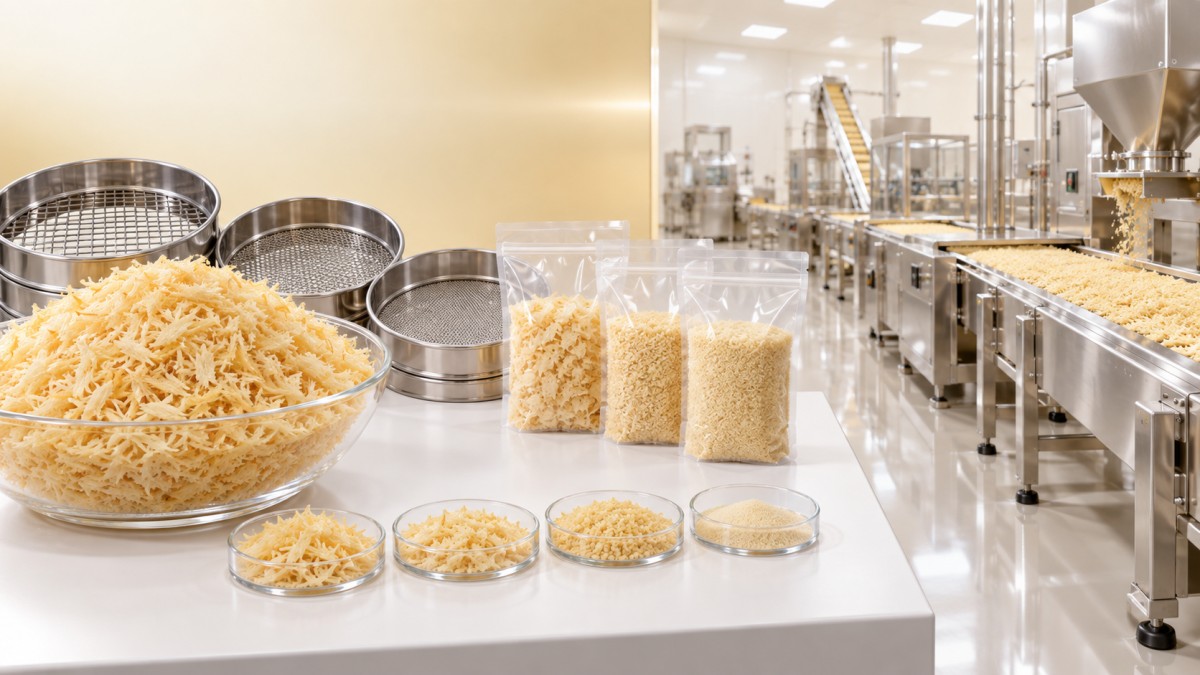
Crumb geometry deserves attention as well. Needle-shaped crumbs, flakes, and coarse irregular fragments can each produce a different surface texture and bite. Shape influences how crumbs orient during coating, how readily they shed, and the appearance after frying. A specification that says only “panko” leaves too much open to interpretation. Include a retained reference sample where possible, particularly when a product’s visual identity is commercially important.
Connect crumb distribution to coating performance
Uniform crumbs are valuable because they reduce variation, not because uniformity is automatically the right sensory outcome. Fine particles can fill gaps and improve initial coverage, yet too many may produce a denser coating and alter oil uptake. Larger crumbs can create a more open, crisp surface, but may detach if the predust, batter viscosity, pickup settings, or fryer profile are not aligned. The supplier’s material must therefore be evaluated in the intended system rather than judged only by appearance.
Run trials using your normal substrate, predust, batter or adhesion system, breader settings, frying conditions, and post-fry handling. Measure practical outcomes: dry and wet pickup, coating coverage, shed in the breader, fryer debris, colour development, texture after frying, and texture after the expected hold or reheating period. Record the trial lot number. If a later commercial delivery differs, that traceability makes the investigation much more efficient.
Do not overlook interaction with moisture. Panko made from wheat flour, water, yeast, and salt may have a simple ingredient declaration, but moisture control and pack integrity remain central to its performance. Excess moisture can affect flowability and crispness; overly dry or poorly protected crumbs may fracture more readily. Ask the supplier how moisture is tested, what release limits apply, and how packaging protects the product during storage and shipment.
Audit the process, not just the certificate
Food safety certification is an important screening tool, but it should not be treated as a complete supplier approval decision. If a supplier states ISO certification, obtain the current certificate, check its scope and issuing body, and confirm that the manufacturing location and relevant activity are covered. Depending on your market, customer requirements, and risk assessment, additional food safety schemes or documentation may be needed. These requirements should be confirmed against the applicable destination-market rules rather than assumed.
For crumb consistency, the manufacturing controls are especially relevant. Ask how the bread is produced, dried, milled or cut, screened, and packed. Electrode-based baking or fermentation methods may contribute to a particular crumb structure, but the buyer should focus on the control points: how are time, temperature, aging, screening, and changeovers managed? Are critical settings documented? Is equipment cleaning validated to prevent unintended carryover between coloured, seasoned, or allergen-containing lines?
An audit, whether on site or conducted through a structured remote review, should examine lot traceability, raw-material approval, allergen controls, pest management, foreign-body prevention, corrective-action records, complaint trends, and release procedures. It is reasonable to ask how quickly the supplier can identify the raw materials and production records connected to a finished lot. A traceability exercise is more informative than a general assurance statement.
Questions that reveal operational maturity
- What particle-size limits apply to the target grade, including fines and oversize material?
- How are samples selected from a batch, and can batch-level test records be supplied with deliveries?
- What controls prevent damage between final screening and shipment?
- How are non-conforming lots isolated, investigated, and dispositioned?
- Can the supplier provide a certificate of analysis or agreed release data for the attributes that matter to your process?
- What notification process applies if raw materials, processing conditions, packaging, or specifications change?
Vague answers are a warning sign. A capable supplier may protect confidential details, but should still explain the control logic, provide relevant records, and engage constructively with an agreed specification.
Evaluate samples as a controlled qualification exercise
One sample is a starting point, not proof of repeatability. Request samples from more than one production lot where the project allows. Keep them identifiable, test them under the same conditions, and compare size distribution, coating behaviour, sensory outcome, and packaging condition. Sample orders with manageable quantities can be useful for this purpose because they allow plant trials without forcing an early volume commitment.
For example, a yellow, needle-shaped grade specified at 5–6 mm may be suitable for fried chicken, chicken wings, seafood, shrimp products, steak-style items, onion rings, or sweet potato balls. The question is not whether that format is broadly suitable; it is whether its specific particle profile fits your line. A product such as Japanese Needle-Shaped Bread Crumbs / Panko (Yellow) can serve as a useful evaluation reference when its stated size, colour, and desired texture match the application, but qualification should still include lot comparison and production trials.
Make trial acceptance conditional on the same details that will govern commercial supply. Agree the product code, approved sample, pack size, pallet configuration, shelf-life expectations, storage conditions, inspection criteria, and change-control expectations. Otherwise, the material ordered later may be described by the same name while differing in the characteristics that made the trial successful.
Capacity, logistics, and change control are quality issues
Supply reliability has a direct effect on consistency. A Japanese Panko supplier may have the right sample but lack sufficient capacity, predictable lead times, or packaging robust enough for export distribution. Ask about normal production capacity, planning horizon, minimum order conditions, inventory policies, and contingency arrangements. A stated capacity of 50 tonnes per day may indicate meaningful manufacturing scale, but it should be considered alongside demand allocation, product mix, maintenance downtime, and the supplier’s commitments to other customers.
Export experience can also matter because documentation, palletisation, humidity exposure, and shipment duration all influence the delivered condition of a fragile crumb. Suppliers serving multiple international markets may be familiar with these requirements, but buyers should still verify the specific destination’s labelling, allergen declaration, import documentation, and food safety obligations.
Change control is often underestimated. A new flour source, altered drying condition, revised bag film, or screen replacement can affect crumb characteristics even if the ingredient list remains unchanged. Require advance notice for changes that could influence food safety, regulatory status, sensory properties, particle size, colour, or processing performance. The agreement should specify whether customer approval or requalification is needed before implementation.
Make the final decision on evidence, not presentation
A dependable panko programme is built on a clear specification, verified process controls, representative trial results, and an open route for resolving deviations. Price matters, but a small apparent saving can be outweighed by inconsistent pickup, product rework, excessive breader loss, or customer complaints tied to appearance and texture.
The strongest supplier relationships tend to treat quality as a shared operating discipline. That means retaining approved references, reviewing delivery performance, investigating variation with data, and planning product development responsibly as customer expectations change. Long manufacturing experience, investment in improved products, careful use of quality raw materials, and attention to greener operations can all be positive signs when supported by practical controls rather than broad claims.
Before approval, ask for the final specification, recent lot data, certification scope, sample-trial records, and a written change-notification process. If those documents align with what your line has demonstrated, you have a sounder basis for selecting a supplier capable of delivering consistent crumbs—not just a convincing first sample.
Tag
Related Products


Leave A Message
If you are interested in our products and want to know more details, please leave a message here, we will reply you as soon as we can.


