
Fat Fish Incident
How to choose bread crumbs for frying that resist oil absorption
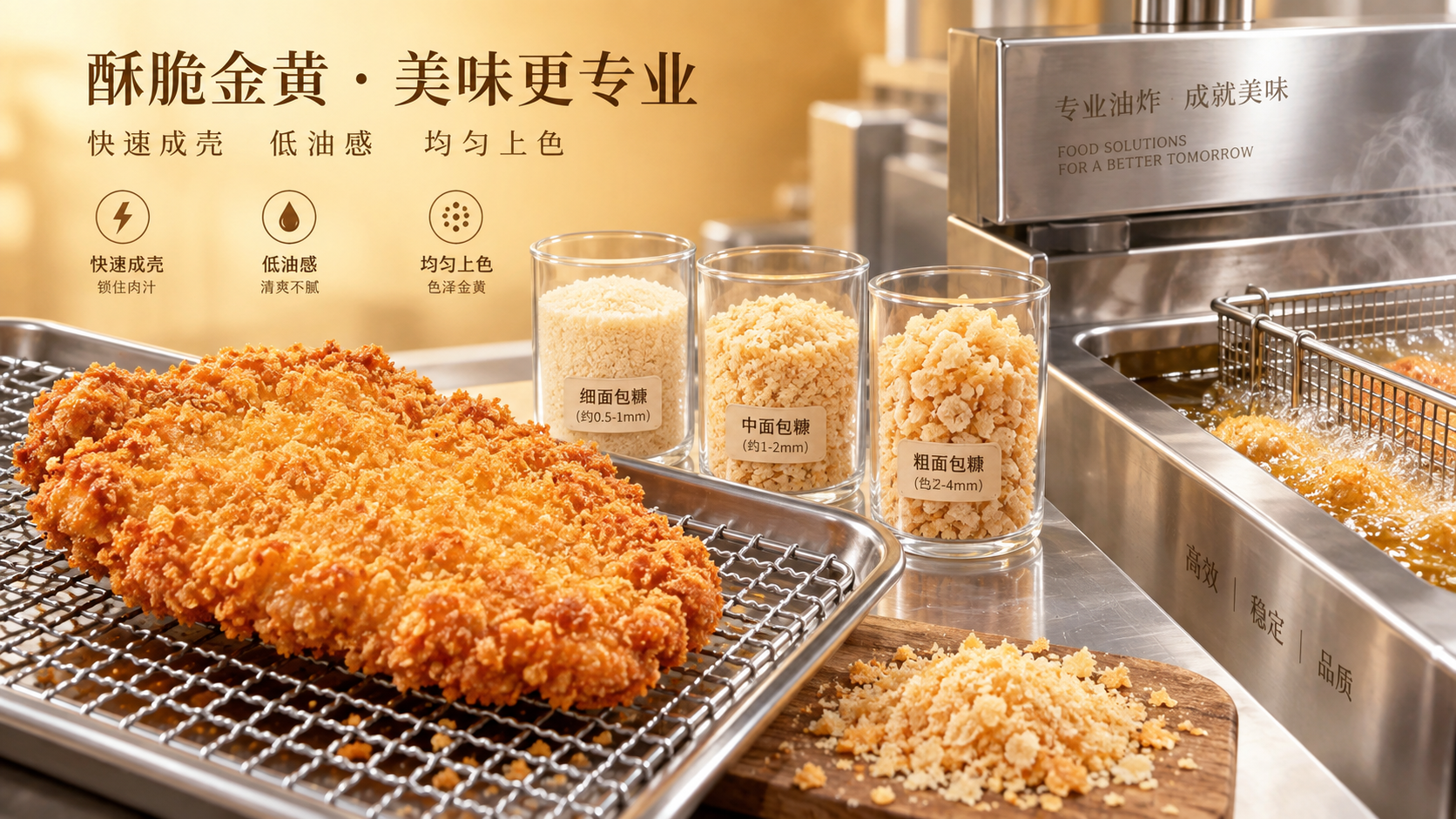
Oil resistance in a fried coating is not determined by one label on a bag of crumbs. It comes from how quickly the crumb layer forms a dry, stable crust around the food. The most suitable Bread Crumbs for frying usually have a consistent particle size, low excess dust, good adhesion to the wet coating system, and enough open structure to become crisp without turning into a dense oil-holding shell.
For a practical purchase decision, begin with the finished product rather than the crumb name. A thin chicken cutlet, a thick frozen croquette, a fish fillet, and a vegetable appetizer do not need the same crumb. The objective is not simply to choose the lightest-looking coating. It is to select a crumb that covers evenly, fries at the required time and temperature, stays attached during handling, and does not become greasy after holding.
What “oil-resistant” really means in a fried coating
Bread crumbs do not actively repel frying oil in the way a waterproof surface would. Instead, a well-chosen crumb limits unnecessary oil pickup by creating a crust quickly. During frying, moisture leaves the food and coating as steam. That steam initially pushes outward and helps prevent oil from moving inward. Once the product is removed from the fryer and begins to cool, some oil can be drawn into open spaces in the crust. A weak, cracked, overly fine, or poorly bonded coating gives oil more pathways to enter.
This is why a crumb that looks very porous is not automatically the best choice, and a very fine crumb is not automatically more economical. The coating needs controlled porosity: enough texture for crispness, but a structure strong enough to set before the food overcooks. It also needs to remain intact through battering, breading, frying, draining, packing, and holding.
When evaluating samples, look for the combined result: a dry bite, even browning, limited greasy shine after draining, and a coating that remains attached when cut or bitten. A crumb can appear excellent immediately after frying yet become oily and soft after a short holding period. That later stage is often where a poor match becomes obvious.
Start with particle size, not color
Particle size has a direct effect on coating coverage, crust formation, and oil behavior. It should be considered alongside the dimensions and moisture level of the food being fried.
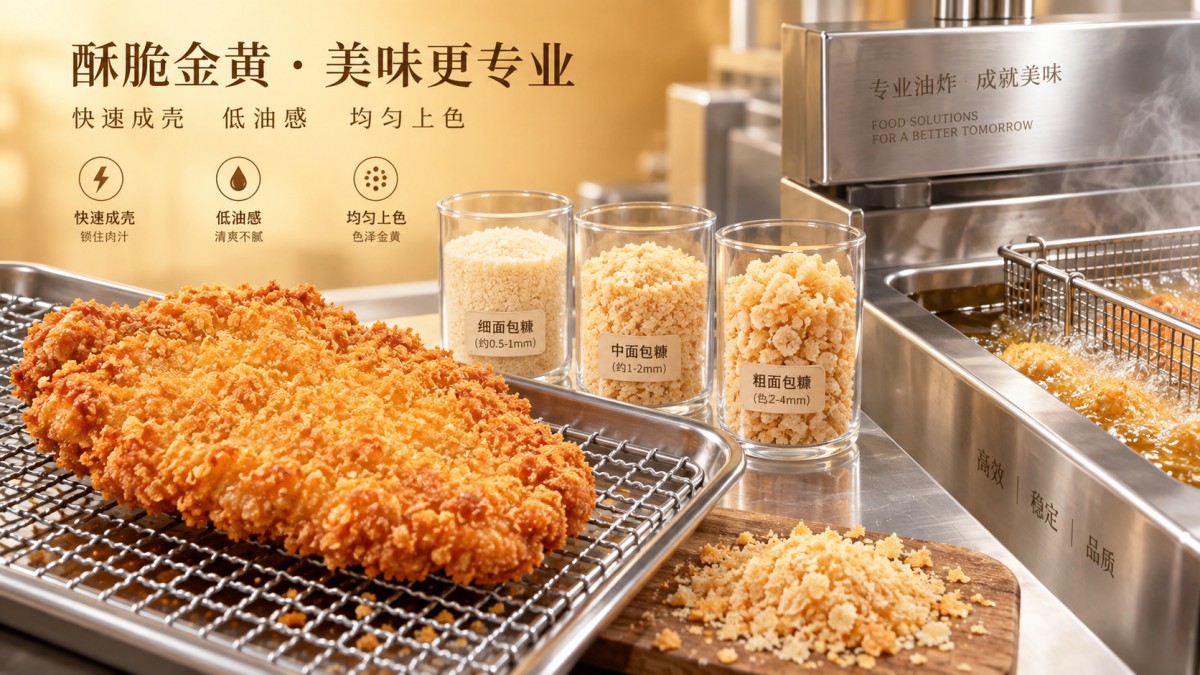
For oil control, a uniform medium-to-coarse crumb often gives the most manageable result because it can create texture without requiring an excessively thick coating. But this depends on the product. A coarse crumb on a small or irregular item may leave bare patches. Oil then enters at exposed areas, while loose flakes can break away and contaminate fryer oil.
A common buying error is judging a crumb from a small dry sample. Inspect the distribution, not just the average size. Too much powder in the bottom of the bag can create a compact layer that darkens early. Too many large fragments can reduce coverage and cause weak adhesion. A stable specification should give similar distribution from one delivery to the next.
The crumb must match the entire coating system
Oil uptake is frequently blamed on the crumb when the real issue starts earlier in the breading line. Bread crumbs are only the outer layer. Flour predust, batter or egg wash, dwell time, coating pressure, and product surface moisture all affect whether the crust sets correctly.
A wet and uneven product surface can create clumps rather than a continuous coating. Too little binder leaves gaps. Too much binder produces a thick wet layer that may trap moisture, delay crust formation, and increase the chance of a heavy, greasy result. If the crumb does not adhere evenly before frying, changing to a more expensive crumb alone is unlikely to solve the problem.
Before switching suppliers, check the coating sequence:
- Make sure the food surface is not excessively wet, icy, or oily before predusting.
- Use a predust that covers the surface without forming heavy dry patches.
- Keep the liquid binder at a workable consistency so it wets the crumb rather than flooding it.
- Allow sufficient setting time where the process permits, especially for formed or frozen items.
- Remove loose crumb before frying, since free particles darken in the oil and shorten the usable life of the fryer oil.
The best crumb choice is therefore one that performs consistently with the binder already used in production. A light panko-style crumb may work well with a suitable batter but perform poorly with a thin egg wash on a highly moist product. Fine crumbs may adhere better to a simple egg wash but can form a tighter shell. Purchase decisions should be based on the complete system, not on dry crumb appearance alone.
Choose structure according to the frying method
Deep frying, shallow frying, air frying, and oven finishing place different demands on a breaded coating. A crumb that resists oil absorption in a commercial fryer may not give the same result in a shallow pan, where only part of the surface contacts oil at one time. Likewise, a crumb designed for deep frying may remain pale or dry-looking in an air fryer unless the process includes a light oil application.
Deep-fried products
For immersion frying, look for crumbs that set quickly and do not release excessive fine particles. An open, evenly distributed crumb can produce crispness efficiently, but it must retain enough strength to avoid shedding. For products with a long fry time, such as thick stuffed items, consider whether the coating will brown too early before the center is properly heated. A slightly less aggressive browning profile may be more useful than the darkest golden color.
Shallow-fried foods
Pan-fried products need reliable adhesion and a more compact, even coverage because turning can disturb the coating. Very large flakes can crush or detach when the item is moved. A medium crumb, sometimes combined with a small portion of finer crumb for coverage, is often easier to manage. The product should also be drained promptly after cooking; leaving it in residual pan oil defeats the purpose of selecting a lower-oil coating.
Frozen or pre-fried products
Frozen foods require special attention because surface frost and internal moisture can disrupt the coating. A crumb may look stable in a fresh-product trial but crack after freezing and reheating. For these products, assess the coating after the full intended process: breading, freezing, frying or oven finishing, and holding. Choose a crumb with reliable adhesion and enough durability for transport rather than selecting solely for initial crunch.
Moisture, freshness, and packaging affect performance
Bread crumbs should be dry and free-flowing, but “dry” is not the same as stale or brittle. Crumbs that have taken on moisture during storage tend to clump, coat unevenly, and form a less crisp crust. They can also introduce variation from one batch to the next even when the frying settings remain unchanged.
When receiving crumbs, check whether the material pours freely, whether the bag contains compressed lumps, and whether the texture matches the approved sample. A noticeable increase in fine dust can indicate damage during handling or repeated movement of bags. Store crumbs in a cool, dry area away from direct moisture exposure and reseal opened bags properly. Open storage near steam, wash-down zones, or active fryers can change coating behavior surprisingly quickly.
Color deserves attention as well, but not as an isolated quality marker. Pale crumbs can still brown rapidly if they contain fine particles or added ingredients that promote color development. Darker crumbs may be suitable for a rustic appearance but leave less room for visual error during frying. The right color is the one that produces the intended finish at the established fryer conditions without forcing a shorter cook time.
Run a useful trial before committing
A meaningful crumb trial should compare samples under the same product weight, coating sequence, fryer load, temperature setting, and draining routine. Frying one sample at a time in a lightly loaded fryer can make almost any crumb appear better than it will in regular operation. Repeated batches reveal whether the coating remains stable as oil becomes more loaded with loose particles.
Use a simple evaluation sheet and assess each sample at several points: immediately after frying, after draining, after the normal holding period, and after reheating if reheating is part of the product process. Record practical observations rather than relying on general impressions:
- Coverage and adhesion before frying
- Coating loss during frying and handling
- Color uniformity across pieces
- Surface dryness versus visible oiliness after draining
- Crunch and structural integrity after holding
- Oil cleanliness and accumulation of loose crumbs
- Appearance after cutting, serving, or packaging
A slightly higher-priced crumb can be the better operational choice when it reduces rework, coating loss, or oil degradation. Conversely, a premium coarse crumb may add cost without improving the product if the line cannot apply it consistently. The decision should account for usable yield and process stability, not only the purchase price per bag.
Problems often mistaken for “high oil absorption”
If fried food appears greasy, confirm the frying conditions before replacing the crumb. Oil that is too cool delays crust formation and gives the coating more time to absorb oil. Overloading the fryer can cause the same temperature drop even when the control setting is correct. Frying at an excessively high temperature has the opposite problem: the outside may brown rapidly, while moisture continues moving from the interior and weakens the coating later.
Draining matters as much as frying. A product removed from the fryer and placed directly into a closed container can lose crispness as steam condenses around the coating. It may then be perceived as oily even if the crumb performed well in the fryer. Use a draining arrangement that allows oil to leave the surface and steam to escape before packing or holding.
Another overlooked cause is old or heavily contaminated frying oil. Loose breading particles darken and circulate in the oil, sticking to fresh coatings and creating a darker, heavier finish. Better crumb retention helps, but filtering and oil-management practices remain necessary for stable results.
A practical buying specification
When discussing bread crumbs with a supplier, avoid requesting only “low oil absorption.” That phrase is too broad to guide a reliable selection. Describe the food being coated, its fresh or frozen condition, the binder system, intended coating weight, fryer method, target appearance, holding time, and whether the product will be packed or reheated.
Then request samples with clearly differentiated profiles, such as a medium uniform crumb and a coarse flake-style option, rather than several nearly identical samples. Ask for consistency in particle distribution, color, aroma, free-flowing condition, and packaging integrity. The most useful supplier relationship is one that supports controlled sampling and repeatable quality checks, because a coating specification only works when the delivered crumb continues to match the approved performance.
For products requiring a clean, crisp fried finish, select a crumb that builds an even crust quickly, stays attached through the process, and remains dry after the expected holding period. A trial that includes real production conditions will show far more than a dry sample ever can.
Tag
Related Products


Leave A Message
If you are interested in our products and want to know more details, please leave a message here, we will reply you as soon as we can.


