
Fat Fish Incident
What to Check Before Choosing a Japanese Panko Exporter for Bulk Orders
Start with consistency, not the quote
When you are evaluating a Japanese Panko exporter for bulk orders, price is only one line in the decision sheet. The real question is whether that supplier can deliver the same crumb structure, color, frying performance, and documentation every time your order lands. For business evaluators, that matters more than a short-term discount, because supply inconsistency usually costs more than a higher unit price.
The checks below are the ones that usually separate a workable export partner from a risky one.
What product details should be confirmed before comparing suppliers?
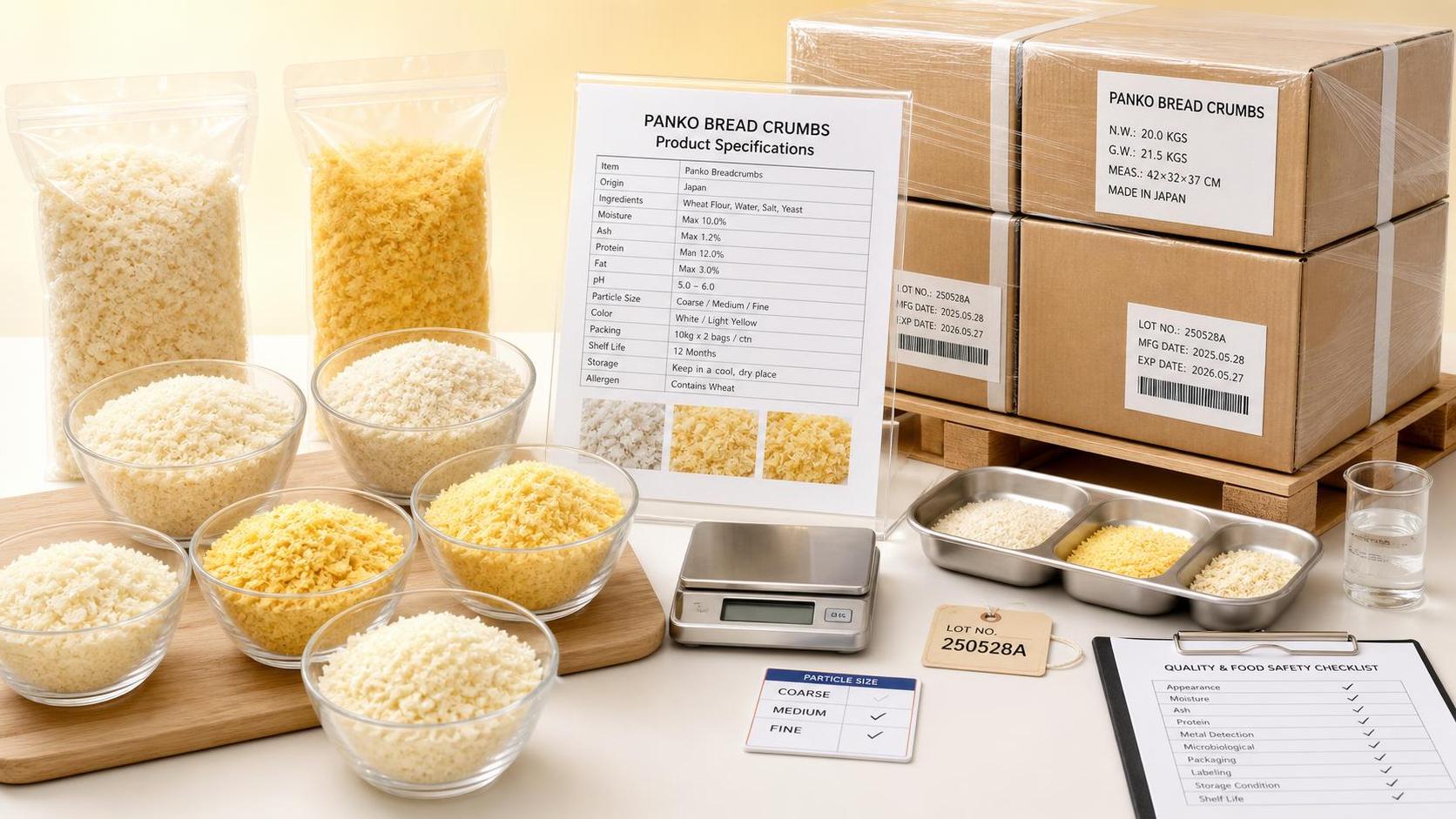
Ask for a full product specification before you compare offers. “Panko” is too broad to evaluate on name alone. You need to know whether the exporter can supply the exact style your market needs: white or yellow crumb, flake size, moisture level, texture after frying, packaging format, and intended application.
A supplier may look competitive on paper, then fail in kitchen trials because the crumb absorbs too much oil or does not hold well on the coating line. That is why the spec sheet matters early. If your internal team buys by sample only, make sure the approved sample is tied to a written specification and lot-level consistency standard.
Which food safety documents are worth checking first?
Start with the documents that show the exporter has a functioning food safety system, not just a sales brochure. In most evaluations, that means checking whether the supplier can provide current certification records, product specifications, allergen statements, ingredient lists, and lot traceability information.
For a fast screening review, this is usually enough:
- Food safety management certifications relevant to the factory
- Finished product specification sheet
- Allergen declaration
- Shelf life and storage conditions
- Packaging material information
- Traceability or batch coding method
If the exporter also handles other bakery or flour-based items, their documentation style can tell you a lot about process maturity. For example, a supplier offering items such as Whole Wheat Burrito with clear ingredient disclosure, size options, and certifications like BRC, HACCP, and ISO is often easier to assess across categories because the paperwork discipline is already there. That does not prove panko performance by itself, but it does reduce the chance of documentation gaps.
How do you judge whether export capacity is real?
Do not rely on monthly capacity claims alone. Ask how the supplier handles peak season scheduling, lead times, container planning, and repeat orders with the same specification. A capable Japanese Panko exporter should be able to explain production planning in practical terms: minimum order quantity, normal replenishment cycle, loading pattern, and what happens if you need an urgent reorder.
One common mistake is approving a supplier based on trial-order responsiveness. Small sample shipments tell you almost nothing about whether the factory can support regular pallet or container volumes without changing raw material sourcing, production windows, or pack configuration.
What makes a sample test meaningful?
A sample only helps if you test it under the same conditions as your actual use. For panko, that usually means checking pickup, adhesion, frying color, texture retention, oil absorption, and plate appearance after holding time. If you sell into foodservice, test the crumb on the final menu item. If you supply retail or industrial users, test it on the actual production line.
Also ask whether the sample came from standard production or a hand-prepared batch. That answer matters. A hand-selected sample can pass a sensory review but fail once commercial-scale production begins.
Can the exporter support private label or custom specifications?
If your business needs private label, custom particle size, or market-specific packaging, raise that before price negotiation. Many supply problems start because customization was discussed informally and never translated into an approved specification pack.
You want to know three things: whether the exporter accepts customization, how they control version changes, and what approval steps are required before shipment. If pack artwork, labels, or language rules apply in your destination market, the supplier should be able to work from a controlled final file rather than a moving email thread.
Which commercial terms deserve extra attention?
The lowest quote can still be the most expensive option if the trading terms are vague. Review these points carefully:
If a quotation leaves these points open, the comparison is incomplete.
How can you spot reliability issues before placing a large order?
Look for small warning signs in communication and document control. Delayed answers happen. Repeatedly inconsistent answers are more serious. If the exporter sends different specs in different files, cannot explain batch coding, or keeps changing lead times without a reason tied to production or shipping, treat that as an operational risk.
Another useful test is to see how the supplier handles technical questions from QA, purchasing, and sales at the same time. A reliable exporter can usually respond in a coordinated way. If every answer depends on one salesperson forwarding messages back and forth, scaling the relationship may be difficult.
Should you evaluate the broader product portfolio too?
Yes, but for a practical reason: it shows whether the supplier can support category expansion later without rebuilding the approval process from zero. If the same exporter also provides other bakery or prepared flour products for restaurants, supermarkets, or hotels, that can simplify future sourcing reviews.
For instance, a portfolio item like Whole Wheat Burrito, offered in circular 6, 8, 10, and 12-inch formats with standard ingredient disclosure and handling-friendly characteristics such as thin, soft texture, suggests the supplier is used to serving professional food channels. That should not replace a panko-specific audit, but it can strengthen the case for supplier continuity across product lines.
What is a sensible final decision rule?
Choose the Japanese Panko exporter that gives you the clearest match on four points at the same time: verified specification fit, complete food safety paperwork, stable export execution, and workable commercial terms. If one of those is weak, the order is not really low risk, even when the sample looks good and the price is attractive.
A practical sequence is simple: lock the product spec, validate documents, run application testing, then negotiate the order terms. That order prevents a lot of avoidable mistakes.
Tag
Related Products


Leave A Message
If you are interested in our products and want to know more details, please leave a message here, we will reply you as soon as we can.


