
Fat Fish Incident
Which bread crumbs for fish keep delicate fillets from breaking
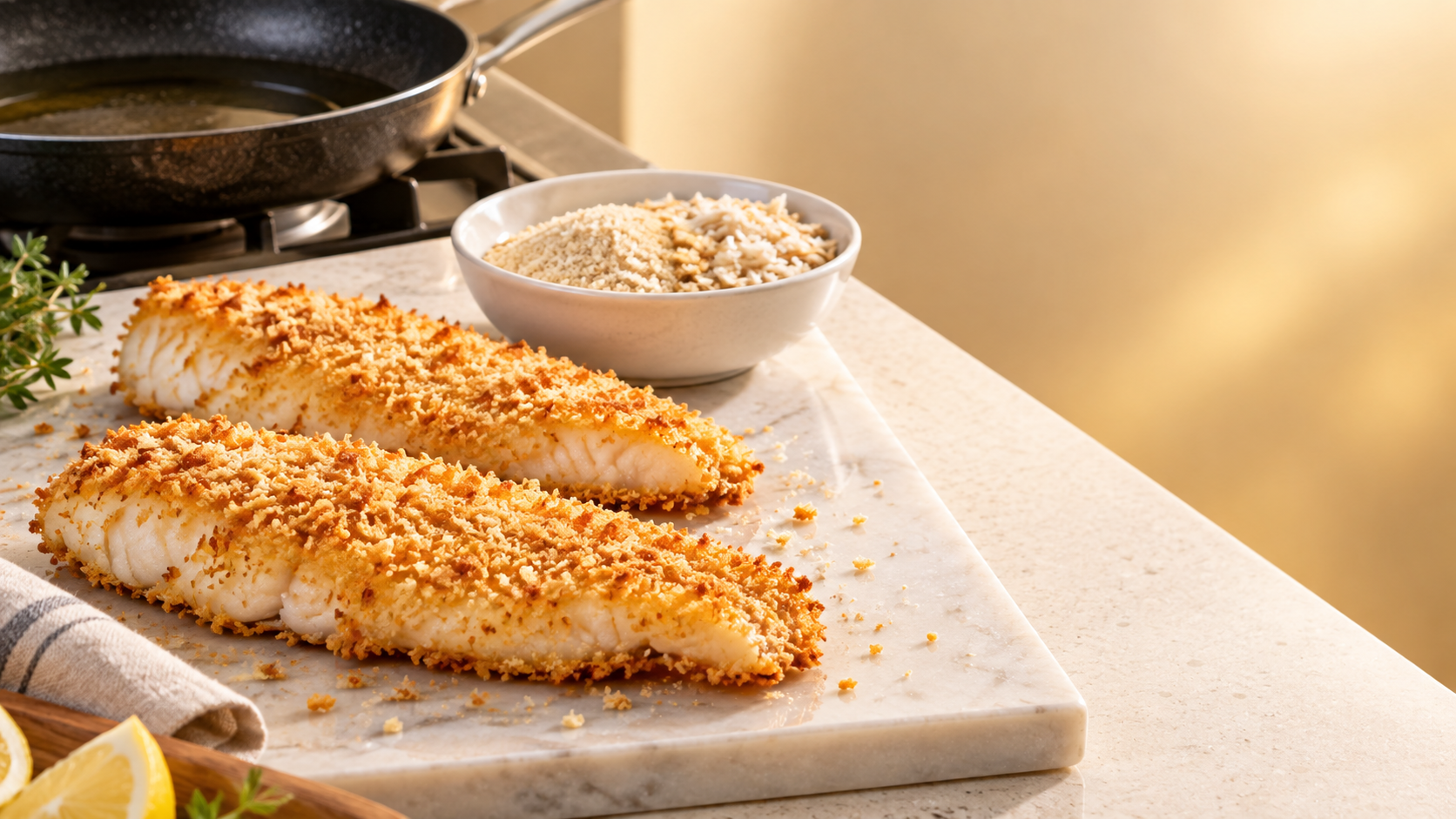
For delicate fish fillets, the safest choice is a fine, dry, evenly milled breadcrumb applied in a thin layer. Fine plain crumbs or fine panko-style crumbs protect the surface without adding enough weight to pull flaky flesh apart. Large, coarse, heavily seasoned, or moist crumbs are more likely to detach during turning, create uneven browning, and encourage the fillet to split where it is already thin.
The crumb alone cannot hold a weak fillet together. It works as part of a coating system: a dry fish surface, a light flour layer, a controlled wet binder, and crumbs that match the thickness and cooking method. When these layers are balanced, the crust sets before the fish has to be moved repeatedly.
Choose crumb size according to fillet strength
Fine breadcrumbs are usually the most reliable starting point for sole, flounder, pollock, tilapia, thin cod portions, and other fish that bend easily. Their small particles cover shallow tears and irregular surfaces with fewer gaps. Because the layer is compact, it needs less egg wash or batter to adhere. That matters when handling soft fish: excess wet binder becomes a slippery layer between the fish and crumbs rather than a secure adhesive.
Fine panko can give a lighter, more open crust, but it should be screened or selected in a smaller grade for fragile fillets. Standard coarse panko is useful when the fillet is thick enough to support it, such as a firm loin portion or a formed fish portion. On a very thin fillet, its larger flakes create leverage. When the fish is turned, individual flakes can catch on the pan, basket, or tongs and lift the coating away from the surface.
Traditional dry white breadcrumbs offer a more continuous shell than large-flake panko. They are often preferable for shallow frying because they make broad, even contact with the oil and color predictably. Golden crumbs may be used when a darker appearance is wanted, but their existing color can hide early signs of overheating. With delicate fish, visible pale areas are useful because they show where the coating is too thin before frying begins.
Why delicate fillets break even with the right crumbs
A coating failure is often mistaken for a crumb problem when the fish has actually lost strength before breading. Fish that has thawed unevenly, held too long after thawing, or absorbed excess water has a softer surface. Moisture dilutes flour and egg wash, then turns to steam in the pan. The coating lifts first, and the flesh tears when an attempt is made to reattach it with a spatula.
Surface moisture should be removed gently with absorbent paper or a clean food-safe towel. Do not press hard enough to compress the flesh. The goal is a matte surface, not a dry or damaged one. If liquid continues to bead after blotting, allow the fillet to rest briefly on a rack under suitable chilled conditions rather than applying more flour immediately. Repeated flouring creates a pasty layer that separates during cooking.
Thin tail sections need special treatment. They cook and stiffen before the center of the fillet, so an overly thick crumb layer on the tail can break as the fish contracts. Trim loose fragments, fold only when the portion specification permits it, or use a smaller crumb grade on the narrow end. A uniform coating thickness is more useful than a visually dramatic crust.
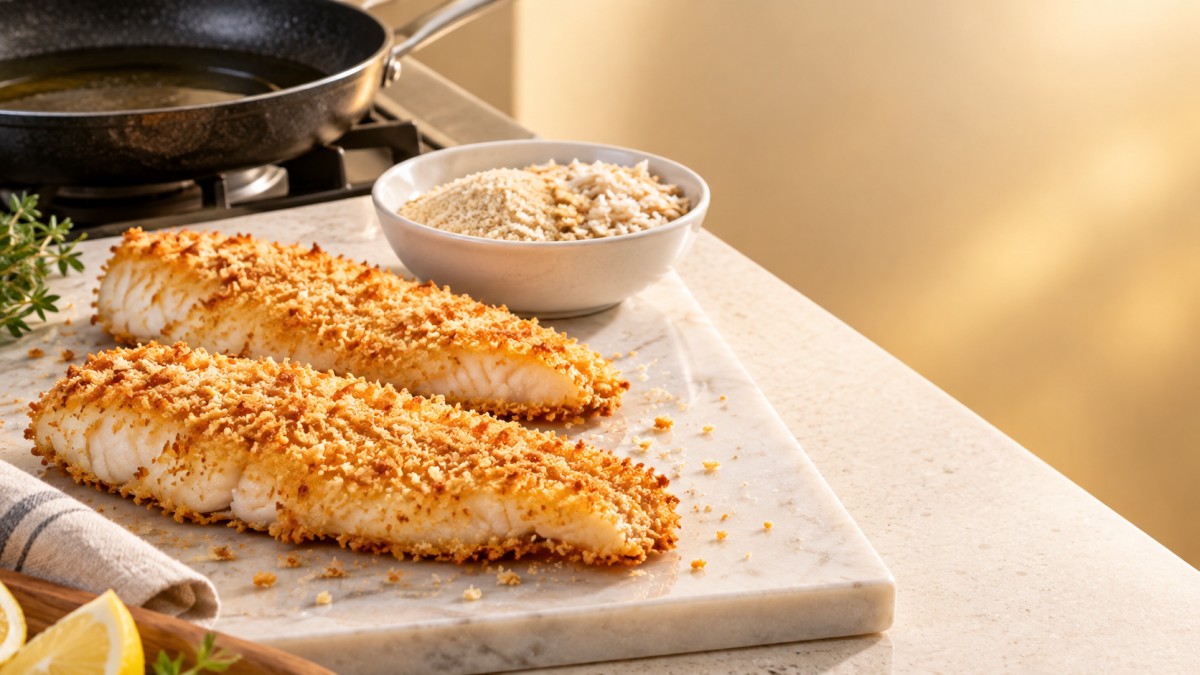
Build the coating without stressing the fish
Set up the breading sequence so the fish travels in one direction: seasoned flour, wet binder, then crumbs. Returning a fillet to an earlier tray causes clumps and increases handling. Keep the flour loose and dry. A light dusting gives the binder something to grip; a thick flour coat creates a soft layer that can slide away from the fish.
For egg wash, use enough liquid to flow in a thin film. An overly thick egg mixture forms heavy ridges, especially in natural creases and near the belly flap. Those ridges take longer to set in hot oil and can make the crust peel in sheets. Drain the fillet briefly after the wet stage. The surface should look coated, not dripping.
- Lay the fillet into flour and turn it once with a broad, gentle motion. Lift it by supporting as much of the length as possible rather than pinching a narrow corner.
- Remove loose flour with a light shake. Large dry patches will later form weak spots because the binder cannot reach the fish evenly.
- Pass the fillet through the wet binder without soaking it. Let excess liquid fall away before it enters the crumb bed.
- Place crumbs over the top surface, then use the open hand to settle them into place. Avoid pushing the fillet down into crumbs; downward pressure can fracture soft flesh and create a compact crust.
- Lift from beneath with a fish slice, sheet, or tray. Do not drag the coated fillet across the work surface.
Resting the coated fish briefly before cooking improves adhesion because the flour, binder, and crumb layer hydrate into a connected film. The rest should be controlled: an extended hold in a humid environment softens the crumbs, while uncovered storage can dry exposed edges. Transfer in a single layer, leaving space between portions so the coating is not compressed.
Match the crumb to the cooking method
Shallow frying creates direct contact between the lower crust and the pan. Fine breadcrumbs are especially effective here because they form a consistent contact layer. Add the fish only after the cooking fat has reached a stable frying condition. If the pan is insufficiently heated, the coating absorbs fat before setting and becomes weak. If it is too hot, the crumb colors before the flesh gains enough firmness to release cleanly.
Once the fillet is in the pan, leave it undisturbed until the lower coating has formed a crust. Early movement is a common reason for broken fish. A fillet may appear stuck when the crust is simply not ready to release. Sliding a thin fish turner under one edge is a better test than lifting the whole portion. When resistance remains strong, allow more time rather than forcing the turn.
Deep frying gives more even heat around the coating but introduces a different risk: crowding lowers oil temperature and makes crumbs absorb oil. Fine panko or fine dry crumbs work well when they are evenly distributed and loose particles are removed before loading. Loose crumbs darken quickly in the fryer, transfer bitter flavor, and can adhere to the next batch. Filtering and removing debris between production runs keeps the coating color more consistent.
For oven baking or air frying, a light oil application promotes color and helps the crumb layer set. Coarse crumbs can remain pale and dry in these methods, particularly on moist fish. Fine crumbs or a blend weighted toward fine particles tend to cover better and require less surface oil. Place portions on a preheated, lightly prepared tray or rack only when the cooking setup supports it; sticking on the underside can tear a fillet during removal even when the top crust is intact.
Seasoning and added ingredients can weaken the coating
Salt, sugar, dried herbs, and spice powders should be considered by particle size and cooking behavior, not only flavor. Fine seasoning mixed evenly through breadcrumbs is less likely to create gaps. Large herb pieces, grated cheese, or wet flavor pastes interrupt the crumb layer and often darken ahead of the breadcrumbs. When such ingredients are required, use them sparingly and keep the base crumb fine enough to bridge around them.
Crushed nuts, seeds, and cereal flakes create attractive texture but are not the first choice for fragile fish. Their hard, uneven pieces concentrate pressure during turning. They work better as a partial top coating over a stable fine crumb base than as the entire breading layer. The same logic applies to mixed snack crumbs. A dry, uniformly processed material is easier to evaluate than a blend with oily or sugar-coated fragments. For example, a separate snack item such as Chocolate-flavored dehydrated durian should remain outside fish-breading preparation because its sweet coating and fat profile are not compatible with a neutral frying crumb system.
Read the failure pattern before changing the crumb
If the crust falls away in a large sheet, inspect the flour and wet-binder stages first. The fish may have been too wet, the flour may have clumped, or the binder may have been applied too heavily. Switching from panko to fine breadcrumbs will not correct a wet, slippery interface.
If the fish cracks through the center while the crust stays attached, the portion was likely moved before the flesh had set, or it was bent while being transferred. Use a wider support tool and reduce the distance between breading station, tray, and cooking surface. A narrow spatula can split a delicate fillet even when the crumb choice is appropriate.
When only the tapered ends lose coating, the crumb grade may be too coarse for that part of the fillet, or the ends may have dried more than the center. Apply a lighter, finer layer at the edges and avoid stacking coated portions. If dark patches appear before the fish is cooked, reduce loose crumb debris, assess frying temperature, and check whether seasoning particles are browning ahead of the breading.
For most tender fish, start with fine plain breadcrumbs or fine panko, use a restrained binder layer, and handle the portion from below. That combination gives the coating time to become a protective shell instead of becoming another source of stress on the fillet.
Tag
Related Products


Leave A Message
If you are interested in our products and want to know more details, please leave a message here, we will reply you as soon as we can.


